
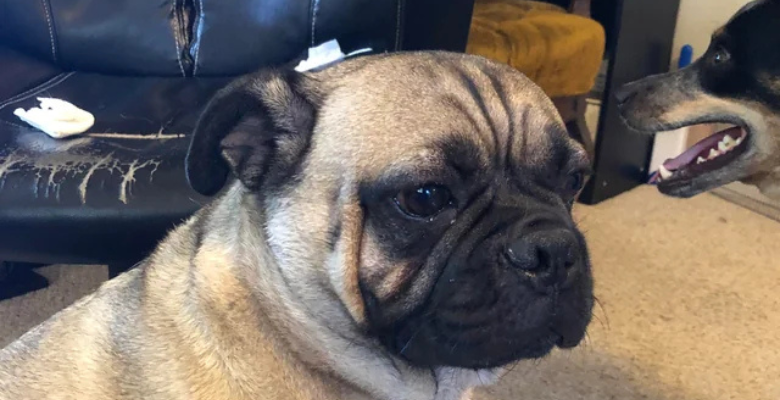
Pugs are not exactly known for their athletic prowess. They are small, flat-faced, breathe with audible effort even at rest, and were essentially bred over centuries for the singular purpose of lap-sitting in the homes of nobility. Their compressed airways, their compact and heavyset bodies, their tendency to overheat in warm weather — none of these qualities suggest a creature destined for high-altitude adventure. So when Buddy — an entirely ordinary pug with a pair of extraordinarily determined owners — reached the top of a mountain on his own four paws, the achievement said far more than simply “this dog is sporty.” It said something about belief, patience, and what becomes possible when someone refuses to let a label become a ceiling.
It all started simply enough, as the best stories usually do. Buddy’s owners were passionate and experienced hikers who had always found meaning and joy in the mountains, and when Buddy joined their family, they faced a choice that many active pet owners will recognize: leave him behind, or bring him along and see what happened. They chose the latter. The first outings were short and unhurried — more leisurely neighborhood stroll than genuine outdoor adventure, designed to introduce Buddy to the experience of walking on natural terrain without overwhelming him. For a breed with known respiratory limitations, even moderate exertion in the wrong conditions can become uncomfortable quickly, and his owners were appropriately cautious.
But Buddy showed something in those early outings that nobody had quite anticipated: he wanted more. He would reach the end of each trail still visibly full of energy, flat snout raised into the breeze, corkscrew tail spinning with the particular enthusiasm that pug owners know well. He was not merely tolerating the experience — he was genuinely thriving in it, actively engaged with the terrain, the smells, the sounds, and the shared activity in a way that communicated unmistakable enjoyment. That was the moment his owners shifted their thinking. If he was handling the short trails with ease and enthusiasm, why not set a more ambitious goal? Why not aim for a summit?
The Training
The serious answer to that question was a carefully constructed and patiently executed training program built entirely around Buddy’s specific needs, limitations, and signals. Speed was never the objective — endurance was. Cardiovascular capacity and physical resilience, developed gradually and without shortcuts, were what the summit would ultimately require. Buddy began with daily walks that grew progressively longer over weeks and months, across increasingly demanding and varied terrain. Gentle inclines became steeper ones. Smooth paths gave way to loose gravel, exposed roots, and uneven rocky ground. His body adapted little by little in response to each new challenge: his paws grew tougher and more confident, his stamina extended noticeably, his stride became more assured even on difficult surfaces.
His owners learned to read him with care and precision throughout the entire process. When Buddy signaled tiredness — a slowing of pace, a particular heaviness in his movement, the specific quality of his breathing that indicated he was working at his limit — they stopped without hesitation, rested, and gave him time to recover fully before continuing. When he was eager and clearly had more to give, they pushed forward together. The training was built on a foundation of genuine respect: it honored the real limitations of his breed without making the mistake of underestimating the specific, individual dog they had on their hands. Several months into the program, Buddy was a different animal — physically stronger and more capable than he had ever been, but also more self-assured and confident when confronted with obstacles that would have stopped him cold at the beginning of the journey.
The Climb
The day of the ascent arrived with all the weight and significance it deserved. The mountain offered no concessions to small flat-faced dogs or their anxious owners — rugged and technical terrain, slippery rocks polished smooth by weather, exposed sections with strong and unpredictable winds at the higher elevations. The family adjusted their entire approach around Buddy’s needs and pace, not the other way around. Frequent rest stops were built into the plan from the beginning. Fresh water was always immediately available. High-value treats were on hand throughout to maintain his energy levels and keep his spirits engaged with the task at hand.
There were genuinely hard moments on the ascent — stretches where the effort was written clearly across every inch of Buddy’s compact body, his breathing heavier and more labored, his paws searching carefully for stable purchase on loose and uneven ground. There were sections where his owners exchanged glances, silently asking each other the question neither wanted to say aloud. But Buddy kept moving. One deliberate step at a time, with the particular quiet and uncomplaining stubbornness that seems to be the exclusive domain of dogs — that refusal to stop simply because something is difficult, that complete absence of self-pity in the face of genuine physical challenge.
The Summit
After hours of steady climbing, the family reached the top. Buddy arrived with them, on his own four paws, under his own power, without being carried for a single step of the journey.
It is genuinely difficult to put into precise words what it means to stand at the summit of a mountain and look down at a pug — a breed that struggles to breathe comfortably on a warm city afternoon — gazing out at the horizon with that flat, inscrutable, deeply satisfied face. For his owners, it was a celebration of everything they had worked toward together: the months of training, the early mornings, the careful and patient progress, the trust that had deepened between them through every shared mile of the journey. For anyone who hears the story afterward, it is something harder to name — a complicated and entirely genuine mixture of amusement, admiration, and, somewhat unexpectedly, real inspiration.
What Buddy Teaches Us
Buddy’s story is not, in the end, a story about pugs or about mountains or even really about dogs at all. It is a story about what becomes possible when someone chooses to believe in the potential of a being the world has already decided is limited — and then has the commitment, the patience, and the love to prove that assumption wrong one careful step at a time.
Buddy did not reach the summit in spite of being a pug. He reached it as a pug, carrying every limitation the breed entails, because he had the benefit of intelligent preparation, constant and attentive support, and owners who understood the crucial difference between genuine care and quiet underestimation.
If a flat-faced, lap-bred pug can stand at the top of a mountain, the question his story leaves behind is a simple and uncomfortably direct one: what exactly is stopping you from reaching yours?

David Bencivenga
Writer, advertising copywriter and SEO analyst, I am originally from New York and have been passionate about reading and writing since I was little. Books have always been my companions and favorite pastime, which led me to my profession. I hope you enjoy each of my texts and that they can help you in some way. Happy reading!