
Why Do Cats Push Objects Off Tables?
Introduction
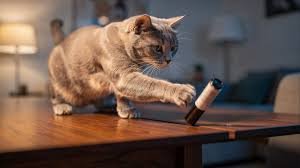
Any cat owner has witnessed the scene: the feline slowly approaches an object on the table, fixes its gaze on it, extends a paw, and with a deliberate and apparently satisfied movement, pushes the object until it falls to the floor. Afterward, it often looks directly at the owner with an expression of absolute indifference. For those who live with cats, this behavior is at once baffling, irritating, and undeniably funny.
But why do cats do this? Is there any logic behind this seemingly destructive and defiant behavior? The answer is yes, and it reveals fascinating aspects of feline psychology and instincts. Understanding the motivations behind this habit helps owners deal with it more effectively and see it in a different light.
The Main Reasons Why Cats Push Objects
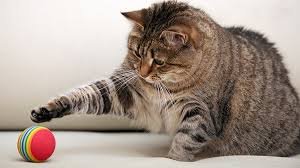
- Hunting Instinct and Exploration The most well-founded reason from an ethological standpoint is the predatory instinct. Cats are natural hunters, and much of their everyday behavior is shaped by this instinct, even in animals that have never needed to hunt for food. By pushing an object, the cat is essentially testing whether it moves, whether it represents a potential prey, or whether it offers any interesting response.
The feline paw is an extremely sensitive hunting instrument, full of nerve endings that allow the animal to detect texture, temperature, weight, and movement with great precision. Touching and pushing objects is a way of investigating the environment and evaluating possible prey. A glass that wobbles before falling, for example, mimics the erratic movement of small prey, which can be highly stimulating for the feline.
- Attention Seeking One of the most practical motivations behind the behavior is simply to get the owner’s attention. Cats are highly observant animals and quickly learn which behaviors generate a human response. If at some point the owner reacted to seeing the cat push an object — whether by rushing to save the item or by reprimanding the animal — the cat registered that this behavior produces attention.
From the cat’s perspective, any reaction from the owner, whether positive or negative, represents a successful outcome. Animals that do not receive sufficient stimulation and interaction tend to develop attention-seeking behaviors more frequently. In this context, pushing objects off tables is an effective strategy that the animal learns to repeat.
- Enrichment and Mental Stimulation Cats have a genuine need for mental and physical stimulation. In poorly enriched environments, where there are not enough toys, adequate interaction, or cognitive challenges, felines seek to create their own source of entertainment. Objects on tables, shelves, and countertops represent convenient targets for exploration and manipulation.
The behavior of pushing objects provides the cat with a multisensory experience: the movement of the object, the sound of the fall, the environmental response, and the owner’s reaction create a sequence of stimuli that the animal can reproduce repeatedly. In cats with high energy levels and intellectual curiosity, this behavior tends to be more frequent.
- Marking and Territory Control Cats are animals that value control over their environment. Rearranging objects, pushing, or knocking them over can be a way of asserting control over the space and investigating what belongs to their territory. This motivation is more subtle, but contributes to the behavior especially in cats with a more assertive and territorial temperament.
- Natural Curiosity Curiosity is a defining characteristic of felines and is deeply rooted in their behavior. New or unusual objects on elevated surfaces naturally attract the cat’s attention. Pushing is a way of investigating the object, understanding its physical properties, and determining whether it represents any interest, threat, or opportunity.
Why Are Elevated Surfaces the Preferred Setting?
It is no coincidence that this behavior occurs predominantly on tables, shelves, countertops, and other elevated surfaces. Cats have a natural preference for high places, which in nature offer a strategic advantage for observing the environment, identifying prey, and protecting themselves from threats. Elevated surfaces represent positions of power and control in the feline’s mental map.
By positioning itself in high places, the cat also places itself in a prominent position relative to the owner, which can reinforce the attention-seeking dynamic. Objects on these surfaces therefore become natural targets for feline exploration and manipulation.
How to Deal With the Behavior
Enrich the Environment The most effective measure for reducing object-pushing behavior is to ensure the cat has sufficient stimulation in its environment. Varied toys — especially those that simulate the movement of prey — regular play sessions with the owner, scratching posts, climbing structures, and windows with a view of the outside are all ways to channel the animal’s energy and curiosity constructively.
Interactive hunting toys, such as feather wands and electronic toys with autonomous movement, are particularly effective for satisfying the cat’s predatory instinct without it needing to resort to household objects.
Don’t Inadvertently Reinforce the Behavior If the cat’s main motivation is attention-seeking, any reaction from the owner to the behavior functions as reinforcement. The most effective strategy in this case is to completely ignore the episode — without reprimanding or consoling the animal — and offer attention and interaction during moments when the cat is behaving desirably.
Remove Fragile or Valuable Objects From Surfaces A practical and immediate solution is to simply remove from surfaces accessible to the cat any objects that should not be knocked over. Fragile items, electronics, toxic plants, and objects of sentimental value should be stored in places inaccessible to the animal. This measure does not resolve the cause of the behavior, but eliminates the unwanted consequences while other strategies are implemented.
Offer Surfaces and Objects Designed for Exploration Creating specific areas where the cat can freely explore and manipulate objects is a way to redirect the behavior. Some environmental enrichment structures include platforms with safe objects that the cat can move and handle. Boxes with materials of different textures, hidden toys, and objects that roll in a predictable way are alternatives that satisfy feline curiosity in a controlled manner.
When the Behavior Indicates Something More
In most cases, pushing objects is a completely normal and harmless behavior. However, if the cat shows signs of compulsiveness — repeating the behavior excessively with no possibility of interruption — or if the behavior is associated with other signs of stress such as aggression, inappropriate elimination, and changes in appetite, a veterinary evaluation or consultation with an animal behavior specialist may be warranted.
Feline obsessive-compulsive disorders exist and can manifest through repetitive behaviors. In these cases, treatment involves environmental modification, enrichment, behavioral management, and in some cases, pharmacological support guided by the veterinarian.
Conclusion
The behavior of pushing objects off tables, far from being an act of deliberate sabotage, is a natural expression of feline instincts for hunting, exploration, attention-seeking, and environmental control. Understanding the motivations behind this habit allows owners to adopt effective strategies for dealing with it without frustration and without compromising the animal’s well-being. With adequate environmental enrichment, regular interaction, and a few practical adjustments to the home environment, it is perfectly possible to live harmoniously with this very characteristic trait of feline personality.

David Bencivenga
Writer, advertising copywriter and SEO analyst, I am originally from New York and have been passionate about reading and writing since I was little. Books have always been my companions and favorite pastime, which led me to my profession. I hope you enjoy each of my texts and that they can help you in some way. Happy reading!