
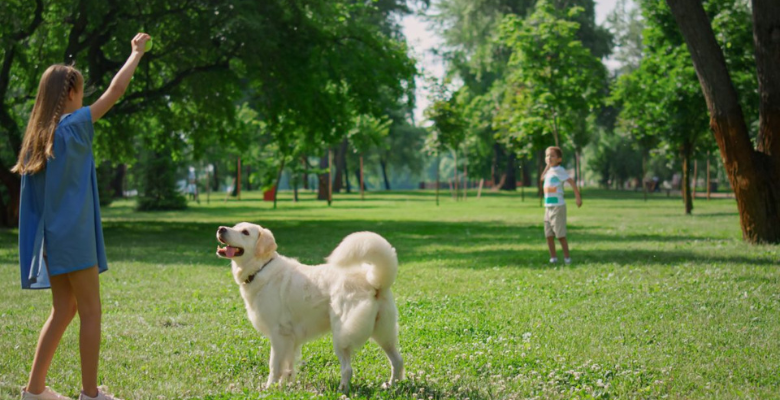
There is something that happens when a child and an animal explore the world together that no classroom can replicate, no curriculum can engineer, and no screen can substitute. The learning that takes place in these moments is not structured or scheduled — it emerges organically from the encounter between a curious, developing human being and another living creature navigating the same world in an entirely different way. Nature becomes a laboratory of endless fascination. The pet becomes a partner, a guide, and an unwitting teacher. And the child learns — about the world around them, about other living beings, and about themselves — without ever fully realizing that learning is taking place at all. That invisible quality is precisely what makes it so powerful and so lasting.
Outdoor activities are already widely and consistently recognized as essential to healthy child development. Time spent outside sparks genuine curiosity about the natural world, builds physical strength and coordination, encourages the development of independence and confidence, and offers experiences of texture, scale, sound, and unpredictability that no indoor environment — however thoughtfully designed — can replicate. The sensory richness of the outdoors, the way it demands presence and engagement, makes it one of the most fertile environments for childhood growth that exists. When an animal enters that equation, the benefits multiply in ways that are both immediate and deeply long-lasting. Alongside a pet, a child does not simply exercise or explore — they also develop compassion, responsibility, patience, and the quiet, profound language of caring for another living being whose needs are real and whose dependence is genuine.
Each outdoor activity shared between a child and an animal delivers something different and valuable in its own right. A run through an open field, a slow walk along a trail, an afternoon by a stream, a morning in the garden — all of these experiences are transformed by the presence of an animal companion. But they share one essential quality: they put the child in motion, in direct sensory contact with the real world, and in active relationship with a being that depends, in some meaningful measure, on their attention and care. That combination — movement, nature, and relational responsibility — is extraordinarily rich developmental territory.
What an Animal Teaches That an Adult Cannot
Children respond to animals in a way that is qualitatively different from how they respond to the adults in their lives, however loving and attentive those adults may be. A pet does not judge performance, does not compare the child to siblings or classmates, does not express disappointment, and does not carry the complex emotional weight that adult relationships inevitably involve. It is simply present — consistently, unconditionally, and without agenda. That creates a uniquely safe psychological space in which a child can express themselves freely, make mistakes without consequence, experiment with caregiving behaviors, and try again without fear of embarrassment or criticism.
Research in child development points consistently to the fact that children who grow up with animals tend to develop greater emotional intelligence, a more robust capacity for managing frustration and disappointment, stronger empathic responses toward both animals and other people, and more resilient social bonds. The animal serves as a kind of emotional regulator — a presence that soothes without words, accepts without conditions, and reflects back to the child a version of themselves that is wholly worthy of love and connection.
But beyond the emotional dimension, there is deeply practical learning taking place. A child who feeds the dog every morning before school, who refills the water bowl, who notices when the cat seems unwell — that child is learning, through direct and repeated experience, that another life genuinely depends on their consistency and attentiveness. They learn that forgetting has real consequences for a being that cannot speak up for itself. They learn that caring is not a feeling alone but a commitment expressed through action, day after day, regardless of mood or convenience. This is one of the most important lessons a human being can absorb — and animals teach it naturally, without lectures, without grades, and without any of the resistance that formal instruction so often produces.
Nature as a Classroom
A walk through the woods with a dog moving ahead, nose to the ground and ears alert, can be a richer educational experience than it appears from the outside. The child watches the animal’s behavior with genuine fascination — the way it freezes at a scent, the sudden shift in attention from ground to sky, the particular alertness that signals something worth investigating. This observation draws the child’s attention toward aspects of the environment they would otherwise walk past without a second glance: an ant carrying a fragment of leaf three times its size, a bird holding perfectly still on a low branch, the sound of water moving somewhere through the trees, the way the light changes at the edge of a clearing. The pet acts as an involuntary and entirely natural guide, continuously redirecting the child’s attention toward everything that is alive and in motion in the world around them.
This kind of experience develops what researchers in environmental psychology call nature-connectedness — a felt sense of belonging to and participation in the natural world that, when nurtured consistently during childhood, tends to translate into more mindful, more empathetic adults with measurably better mental health outcomes, stronger environmental values, and a lifelong capacity to find genuine restoration in natural settings. The child who grows up exploring the outdoors alongside an animal is being given something that will quietly shape their relationship with the living world for the rest of their life.
Creating Memories That Last
Ask any adult about their childhood, and if an animal was part of it, the story will surface almost immediately and with a vividness that more ordinary memories rarely achieve. The dog that secretly crept into the bed on cold nights when the parents weren’t looking. The first time they felt the rough tongue of a calf against their hand. The cat that appeared faithfully at the garden gate every afternoon. These memories have a different texture from most — they are fully sensory, emotionally complete, and remarkably durable. They do not fade the way so many childhood experiences do.
Outdoor adventures shared with animals are not simply good for a child’s development in the measurable, documentable ways that research describes, though they are certainly that. They are the kind of experience a child carries forward into every stage of their life — stored not just in memory but in the body, in the emotional reflexes, in the shape of who they become. In ways they may never quite be able to name or articulate, those early hours spent beside an animal in the open world will have made them more human.

David Bencivenga
Writer, advertising copywriter and SEO analyst, I am originally from New York and have been passionate about reading and writing since I was little. Books have always been my companions and favorite pastime, which led me to my profession. I hope you enjoy each of my texts and that they can help you in some way. Happy reading!